Cancun Cenotes: Beyond the Hotel Zone
Explore the hidden cenotes near Cancun and the famous Ruta de los Cenotes in Puerto Morelos.
Cancun visitors often stick to the beaches, but some of the region’s best natural swimming holes are just a short drive away.
The Iconic Day Trip: Cenote Ik Kil
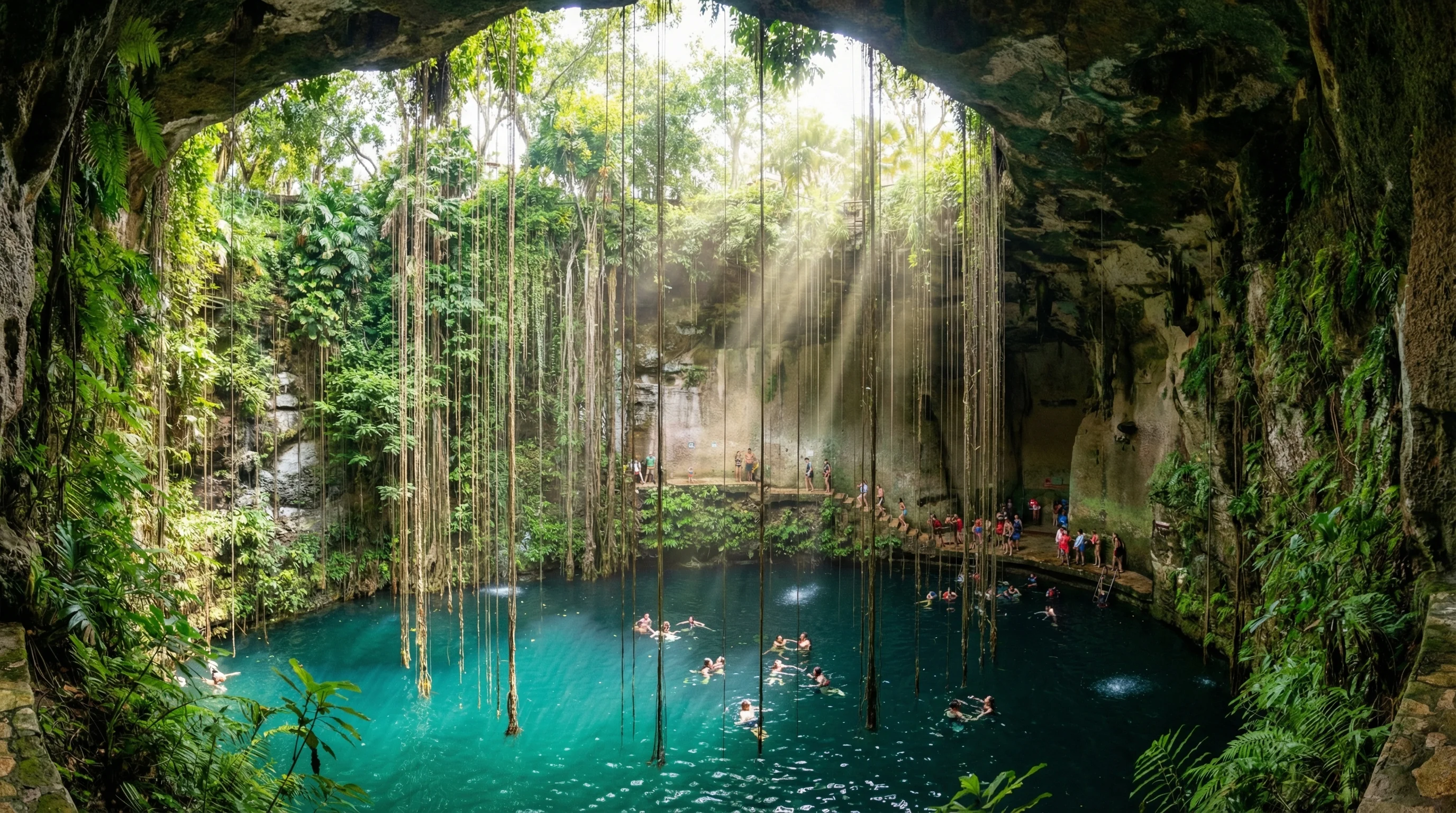
While not technically in Cancun, Cenote Ik Kil is the most famous cenote trip for travelers based in the Hotel Zone. Its proximity to Chichén Itzá makes it a staple of every Riviera Maya itinerary.
Read the Full Cenote Ik Kil Guide →
The Ruta de los Cenotes
The Ruta de los Cenotes: A Comprehensive Guide to Puerto Morelos’ Underground River System
Key Takeaways
- Location: The “Ruta de los Cenotes” is a 35-kilometer corridor stretching west from Puerto Morelos toward Leona Vicario, hosting over 60 cenotes.
- Geology: These formations are part of the Great Mayan Reef system and the Yucatan’s underground river network, formed by the collapse of limestone bedrock.
- Variety: The route features open-air (older), semi-open, and cavern (younger) cenotes, offering diverse experiences from relaxing swims to technical cave diving.
- Pricing: As of late 2025/2026, general admission for individual cenotes typically ranges between $200 and $400 MXN ($10–$20 USD) for swimming only, with adventure packages (ATV/Zipline) costing significantly more ($60–$80 USD).
- Conservation: Strict bans on sunscreen and insect repellent (even biodegradable versions are often discouraged) are in place to protect the fragile ecosystem.
Introduction to the Ruta de los Cenotes
The Ruta de los Cenotes (Cenote Route) is a designated ecological corridor located in Puerto Morelos, approximately 20 minutes south of Cancun and 30 minutes north of Playa del Carmen. Unlike the coastal cenotes that are often crowded with large tour buses, the Ruta de los Cenotes extends inland along the road to Leona Vicario, cutting through dense Mayan jungle.
This region is geologically significant as it sits atop one of the world’s largest underground river systems. The cenotes here act as windows into this subterranean aquifer. The water in these sinkholes is fresh, cool, and filtered through limestone, resulting in exceptional clarity. The route offers a spectrum of cenote ages:
- Cavern/Cave Cenotes: Younger formations where the roof has not fully collapsed (e.g., Siete Bocas, La Noria).
- Open Cenotes: Older formations where the ceiling has completely fallen away, resembling lagoons (e.g., Verde Lucero, Boca del Puma’s open area).
Cenote Verde Lucero
Type: Open-Air Cenote Location: Km 17 (approx.), roughly 20 minutes from Puerto Morelos.
The Experience
Cenote Verde Lucero is widely recognized as one of the most accessible and family-friendly options on the route. It is an “open” cenote, meaning it lacks a cavern roof, exposing the water to the open sky. This results in water that appears emerald green due to the surrounding lush vegetation and algae, though it remains crystal clear for snorkeling.
The topography of Verde Lucero resembles a natural swimming pool with varying depths. It features shallow areas suitable for non-swimmers and children, as well as depths reaching approximately 20 feet (6 meters) to 66 feet (20 meters) in the center. The walls of the cenote are adorned with vegetation, and birdwatchers often spot vultures and songbirds nesting in the trees above.
Key Features & Activities:
- Ziplines: The cenote features a zipline that traverses the water, allowing visitors to drop directly into the pool. There is often a “swing” style zipline as well.
- Cliff Jumping: There are dedicated platforms for jumping, ranging from moderate heights (approx. 3 meters) to higher adrenaline jumps (approx. 7 meters).
- Snorkeling: While it is an open cenote, the water clarity allows for viewing fish, aquatic plants (lily pads), and rock formations.
- Atmosphere: It retains a “family-run” feel, often described as less commercialized than major parks, though it can get busy with tours midday.
Facilities
- Restrooms and changing areas.
- Palapas (thatched-roof shelters) with tables and chairs for picnics.
- Grills are available for visitors who wish to cook their own food.
- Life jackets are generally provided/mandatory.
- Parking is available on-site.
Entry Fees and Logistics (2025/2026 Estimates)
- General Admission: Approximately $300 MXN (~$15–$16 USD) for foreign tourists. Some sources indicate a lower price range of $150–$200 MXN, which may apply to locals or nationals with ID.
- Inclusions: Entry usually covers swimming, use of the zipline, and life jackets.
- Hours: 9:00 AM to 5:00 PM daily.
Cenote Boca del Puma
Type: Eco-Park (Cave Cenote & Open Cenote) Location: Km 16, located within a natural reserve.
The Experience
Boca del Puma (Mouth of the Puma) is distinct from a standalone swimming hole; it is a comprehensive Eco-Park situated in a 250-acre reserve. The experience here is heavily skewed toward adventure tourism combined with geological exploration. The park is home to two distinct cenotes, offering a “best of both worlds” experience.
- The Cave Cenote: This is a subterranean formation featuring stalactites, stalagmites, and fossils. It is described as having a “mystical” atmosphere with light filtering through a hole in the ceiling (a natural skylight). The water here can be quite deep, reaching up to 66 feet, with some sections plunging to over 200 feet.
- The Open Cenote: A second body of water located nearby is open-air, suitable for a relaxing swim after adventure activities.
Key Features & Activities:
- Adventure Circuit: The park is famous for its 7-zipline circuit (700 meters total length), one of the most extensive on the route.
- ATV Tours: Guided ATV rides through the jungle are a primary draw.
- Cultural History: The park includes a “Chicle” (gum) camp simulation, educating visitors on the history of natural gum extraction in the region.
- Wildlife: Spider monkeys are occasionally spotted in the reserve.
Facilities
- Restaurant and snack bar.
- Lockers (often for a small fee, ~$3 USD).
- Restrooms and changing rooms.
- Guides are typically required/included for the adventure activities.
Entry Fees and Logistics (2025/2026 Estimates)
- Cenote Swim Only: Approximately $300 MXN (~$16 USD).
- Adventure Packages:
- ATV + Ziplines + Cenotes: Prices range from $60 USD to $80 USD depending on whether you book a single or double ATV.
- Note: Booking online in advance is recommended for adventure packages to secure spots and potentially receive discounts.
- Hours: 9:00 AM to 5:00 PM daily.
Cenote Siete Bocas
Type: Semi-Open / Deep Cavern Location: Km 15.5, followed by approx. 2km on a dirt road.
The Experience
Cenote Siete Bocas (“Seven Mouths”) is geologically unique and visually spectacular. Its name derives from the seven natural vents (bocas) in the limestone crust that open into the underground river below. These openings allow shafts of sunlight to pierce the darkness, creating a dramatic light show that changes throughout the day.
This cenote is less about “beach-style” relaxation and more about swimming in a vast underground system. The vents are connected by the water, allowing visitors to swim from one opening to another. It is a rustic, rugged experience often favored by those looking to avoid the “theme park” feel of other locations.
Key Features & Activities:
- Light Beams: The interplay of light and shadow is the primary attraction, particularly around midday.
- Cliff Jumping: Visitors can jump from the rock rim into the water at several of the “mouths.”
- Diving: Due to its depth and connection to the larger aquifer, it is a popular spot for scuba diving (certification required) to view rock formations and the “halocline” (where fresh and salt water mix).
- Seclusion: It is generally quieter and more peaceful than parks closer to the highway.
Facilities
- Basic restrooms and changing areas.
- Life jackets (mandatory).
- Picnic areas (limited).
- Note: Facilities are rustic; do not expect restaurants or luxury amenities.
Entry Fees and Logistics (2025/2026 Estimates)
- General Admission: $300 MXN to $400 MXN (~$15–$20 USD).
- Note: Some sources mention a higher price of $600 MXN ($30 USD), which may reflect a guided tour price or a recent price hike for 2025, but $300–$400 is the standard “entry only” rate found in most recent reports.
- Hours: 8:00 AM to 5:00 PM daily.
Cenote La Noria
Type: Cavern / Semi-Open Location: Km 20 (near Cenote Kin Ha), followed by 1.5km on a dirt road.
The Experience
Cenote La Noria is part of the “Tres Reyes” group and is often visited in conjunction with the nearby Cenote Kin Ha. It is a cavern cenote with a partial opening, 18 meters deep and 47 meters wide. The water is fresh and cool, accessed via a rock staircase or a wooden structure.
The atmosphere is distinctly “jungle-like.” Inside the cavern, visitors can often see bats roosting on the ceiling, adding to the subterranean feel. The water is deep blue, and a floating platform in the center allows swimmers to rest. It is described as having a “relaxed and fun vibe”.
Key Features & Activities:
- Camping: Unlike many other cenotes, La Noria offers camping facilities in the Mayan jungle.
- Zipline & ATV: While primarily a swimming hole, they offer ATV circuits and a zipline package for an additional cost.
- Bats: A significant population of bats inhabits the cavern roof, which is a highlight for nature lovers.
- Mountain Biking: The area is a known stop for mountain bikers traversing the jungle trails.
Facilities
- Palapas and rest areas.
- Restrooms.
- Camping zone.
- On-site food (tacos/nachos) is sometimes available, but bringing snacks is recommended.
Entry Fees and Logistics (2025/2026 Estimates)
- General Admission: $200 MXN to $300 MXN (~$10–$15 USD).
- Locals may access lower rates (~$100–$200 MXN) with ID.
- Camping/Packages: Camping is approximately $300 MXN; ATV/Zipline combos are extra.
- Hours: 9:00 AM to 5:00 PM daily.
Comparative Summary Table
| Feature | Cenote Verde Lucero | Cenote Boca del Puma | Cenote Siete Bocas | Cenote La Noria |
|---|---|---|---|---|
| Type | Open-Air (Lagoon style) | Eco-Park (Cave & Open) | Semi-Open (7 Vents) | Cavern / Semi-Open |
| Best For | Families, Relaxing, Open Sky | Adventure Junkies (ATV/Zip) | Photographers, Divers | Campers, Cave atmosphere |
| Est. Price (Entry) | ~$300 MXN | ~$300 MXN (Swim only) | ~$300–$400 MXN | ~$200–$300 MXN |
| Key Activity | Zipline into water | 7-Zipline Circuit, ATVs | Swimming between vents | Camping, Bat watching |
| Location (Route) | Km 17 | Km 16 | Km 15.5 (+2km dirt road) | Km 20 (+1.5km dirt road) |
Practical Guide for the Ruta de los Cenotes
How to Get There
- By Car: This is the most efficient method. From Puerto Morelos, turn west onto the road toward Leona Vicario. The route is well-paved, but the access roads (last 1-2km) to specific cenotes like Siete Bocas and La Noria are dirt tracks that can be bumpy.
- By Taxi: Taxis from Puerto Morelos can take you to specific cenotes. Ensure you arrange a pickup time, as there is no cell signal to call a taxi for the return trip.
- Tours: Many operators in Cancun and Playa del Carmen offer “Cenote Route” tours that include transportation, often visiting 2-3 cenotes in one day.
Essential Packing List
- Cash (Pesos): Most cenotes do not accept credit cards. Bring small bills.
- Swimwear & Towel: Changing facilities are rustic; having dry clothes for the drive back is essential.
- Water Shoes: Highly recommended. The rocks can be sharp and slippery.
- Snorkel Gear: While some rent gear, bringing your own ensures quality and hygiene.
- Food/Water: While some cenotes have snack bars (Boca del Puma), others are very basic (Siete Bocas). Bring water and snacks.
Preservation Rules
- Sunscreen/Bug Spray: Strictly forbidden in the water to protect the chemical balance of the cenote. Even “biodegradable” brands are often asked to be showered off before entering.
- Showers: You must shower before entering any cenote to remove lotions, perfumes, and oils.
- Wildlife: Do not touch the roots of trees descending into the water or disturb bats and birds.
Cenotes in Cancun Cenotes: Beyond the Hotel Zone
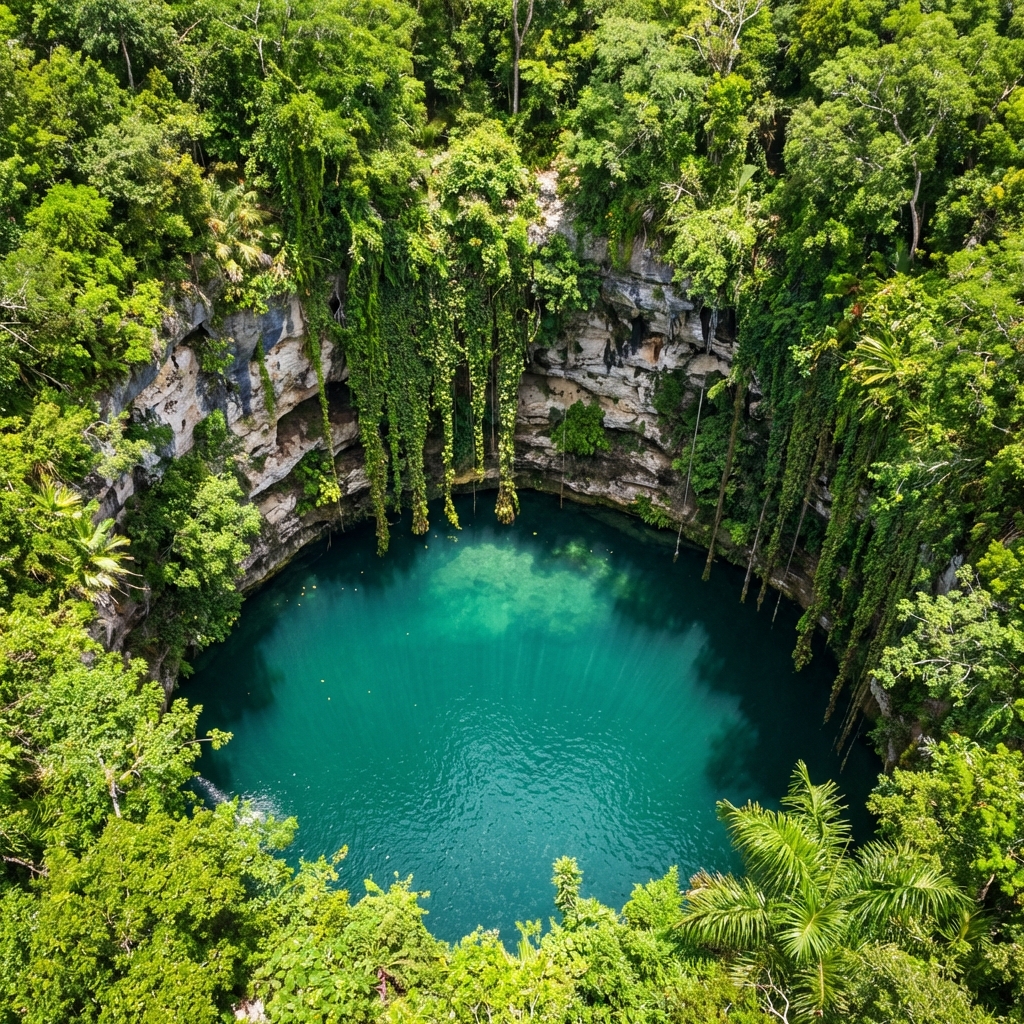
Cenote Ik Kil: The Iconic Sacred Blue Cenote
The Ultimate Guide to Cenote Ik Kil: Mexico’s Most Photographed Wonder
Key Takeaways:
- Location: 3km from Chichén Itzá; …